
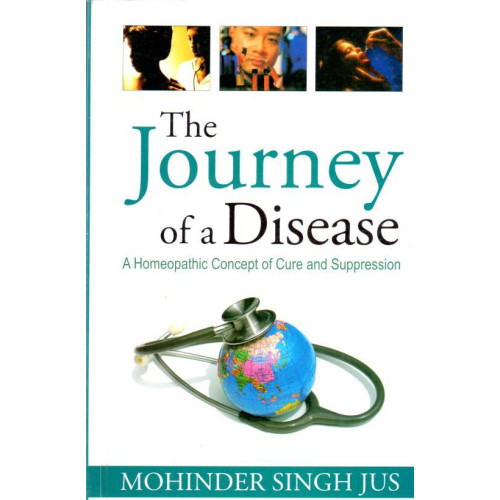
Just a few copies.
Subtitled 'A Homeopathic Journey of Cure and Disease' This 299 page book has developed quite a following since its appearance in 2008. Mohinder Singh Jus has excellent credentials being a keen student of Dr B.K.Bose who was in turn the last living student of Kent.
The book has sold extremely well in Germany and Switzerland. It was originally in German.
It concerns itself with the dangers of suppressive treatment and resultant chronic disease. This is very much a work about the miasms.
Reviewed by Ralf Jeutter:
This book is a translation from German, and is divided in two parts. The first is an introduction to classical Kentian homeopathy. The second deals with the chronic miasms, in which are included Hahnemann's triad plus the tubercular miasm. The book also includes four biographical sketches of 'eminent' homeopaths, namely Boenninghausen, Hering, Kent and Bose of Calcutta, the author's teacher. The territory covered in this book is largely familiar to anyone who has studied Kent's writings. In the first part there are chapters on the 'Law of Similars', the 'Vital Force', 'homeopathic aggravation, 'repetition of dose', etc.
The second part deals with the miasms in a systematic but familiar manner. Characteristic features of the miasms are mentioned, including a head to foot schema. The author views miasms as 'our deep weaknesses', transmitted through the generations, and as expressions of disease types: psora equals 'irritation', sycosis 'blockages' and syphilis 'destruction'. The cure of the miasms is achieved through constitutional treatment, although the author does not provide a list of what he would consider to be psoric, sycotic, syphilitic or tubercular remedies. Being clearly in the tradition of Kent's philosophy, the treatment of the miasms has strong moralistic ovettones, e.g. 'gonorrhoea is a bill for fun'.
The red thread running through this book is the theme of suppression. It is not a systematic exploration of this topic, more the pin, which holds the different chapters together.
The author's style is elegant and easy. It is clear that the author writes from extensive experience and with a gentle cettainty. The last chapter on 'Sensitivity' gives glimpses to his no-nonsense philosophy of life: '... Who feels hurt? An idiot. He ruins his life and makes the lives of others hell.' Happily, the implication is that we can treat idiots well with homeopathy by changing their sensitivity. This is a good and solid book. There is nothing new here. It is for newcomers to homeopathy or those who want an update on Kent's philosophy and prescribing.
Review 2
Homeopathic Links, Volume 20, Winter 2007:
Reviewed by Dr. J. Rozencwaijg, New Zealand:
Quite an impressive title! A look at the contents shows that the book is divided into Part 1: Introduction to Classical Homeopathy and Part 2: Journey of a disease -Chronic Miasms.
My first reaction was "another one of those annoying basic books". Fortunately I am in the habit of reading a book from cover to cover before writing my review and I was in for a treat. Indeed Jus does go through the history of homeopathy, Hahnemann's life and the different aspects of homeopathy like small doses, potentisation, law of cure, repetition, palliation in Part 1 but definitely not in the narrative manner we are used to reading. Reasoning, philosophy, discussion, examples highlight those basic principles in such a way that even for the seasoned practitioner it becomes a delight to read. It's never boring, even though you know quite well what is to come; it is deep teaching with a light touch.
Selling very well at our special price of £5.99. As at 19 Aug, half our stock has sold in just 3 days.
Going through the miasms in Part 2, Jus gives us a very precise description of each miasm, starting with the Generalities and following through the repertory's order, from organ to organ, system to system, comparing different miasms on the way where there might be a confusion. This is one of the clearest texts explaining miasms I have ever read!
He concludes his book by writing about the menopause and vaccination; but, again, not in the usual way! He describes menopausal symptoms and vaccination effects according to the patient's miasm, therefore helping to understand how and why the symptoms differ.
And yet all this is perfectly classical, there is indeed nothing new, no discovery, no revelation but a simple and clear expose of what has always been a difficult subject to understand and teach.
We are witnessing lots of "new and improved" ways of practising homeopathy, and lots of discussions, not to say bickering, about these methods.
It is refreshing to see that a Master of Homeopathy has taken the time to write a book on the basic principles of the art and science we practise.
I would definitely recommend this book not only to all students but as a pause for reflection for each and every practitioner, going back to the basics and the roots of homeopathy.


